Puyallup LTARE, Soil Health in Reduced Tillage and Animal-integrated Diversified Organic Cropping Systems
The Washington Soil Health Initiative (WaSHI) has funded a network of Long-Term Agroecological Research and Extension (LTARE) sites. Our location is the only certified organic LTARE site in the WaSHI network and was established in 2022. The 2-acre field experiment represents the nearly year-round, annual diversified vegetable rotations that are common in Western Washington. Check out more details on our WSU Puyallup LTARE
Experimental design and initiation
The Puyallup LTARE focuses on organic vegetable production, reduced tillage, and animal integration. The experiment was established in fall 2022 following a sudangrass summer cover crop across all plots. From 2015-2022 plots were maintained in grass pasture and from 2003 to 2014 plots were utilized in a different long-term experiment (see Cogger et al., 2016).
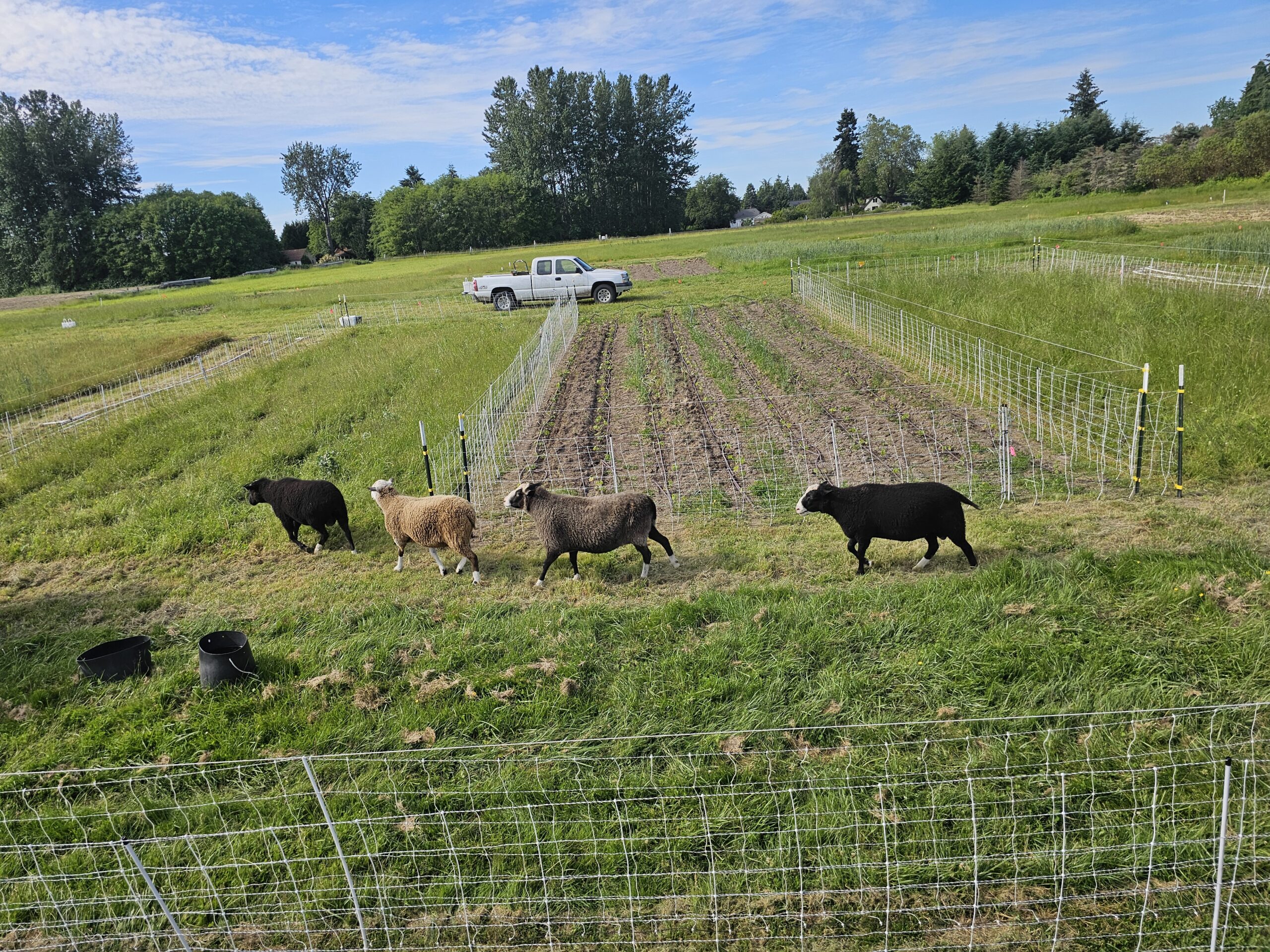
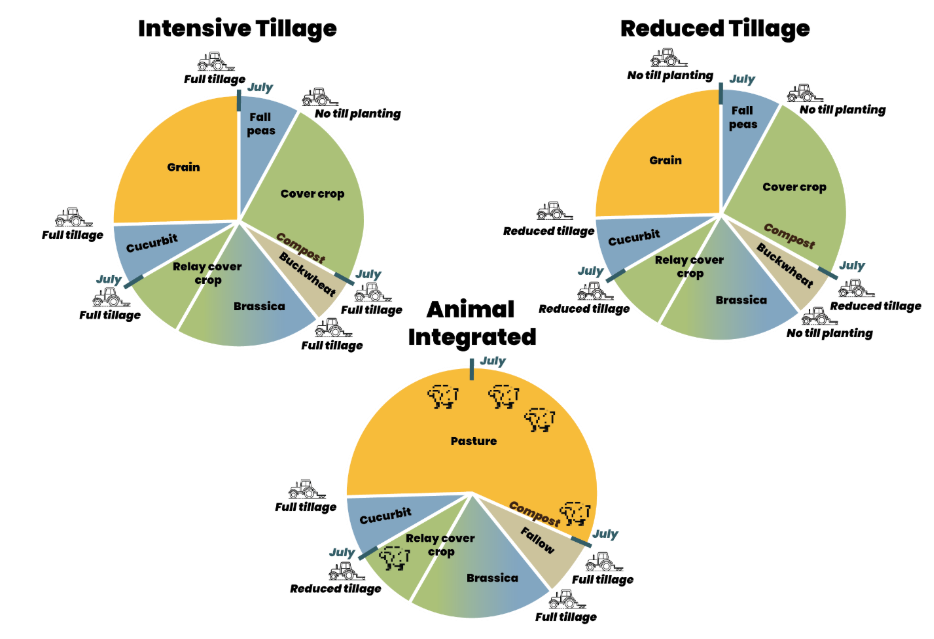
The experiment is a split-split plot experiment with four replications and includes a total of 72 plots. There are 3 cropping systems (main plots): 1) Intensive tillage (IT), 2) Reduced tillage (RT), and 3) Animal integrated (AI). The experiment operates on a 3-year rotation and year of rotation is nested in cropping system (sub-plots) with each year of the rotation represented every year. There are also two levels of compost application nested within the year of the rotation (sub-sub plots): 1) No compost and 2) Compost at 69 dry Mg ha-1 (28 tons a-1) once every 3 years. The IT and RT treatments have a similar crop rotation: fall-broccoli → squash → winter wheat. The AI treatment substitutes short-term pasture (22 months) for winter wheat: fall-broccoli → squash → pasture. IT includes tillage to 25 cm 2 or 3 times per year. RT utilizes strip tillage for squash (disturbance to 15 cm in a 30 cm-wide strip) and shallow disturbance (<5 cm) once or twice per year. The AI system includes a 22-month period with no tillage followed by tillage of the entire bed to 8 cm before broccoli, before squash, and to replant the pasture. Strip-tillage, similar to the RT treatment, was also implemented in AI prior to squash.
In fall 2022 plots were planted to a cover crop, wheat, or pasture depending on the rotation. Alternative tillage strategies and vegetable production were implemented in spring 2023.
Figure 1. WSU Puyallup LTARE three-year rotations across main treatments, Intensive Tillage, Reduced Tillage, and Animal-Integrated. Primary vegetable cash crops are brassicas, and cucurbits. A grain is included in the intensive and reduced-tillage treatments. Pasture and sheep grazing are utilized in the animal-integrated system. A relay cover crop, also known as inter-planting, is seeded with the brassica. Compost is applied to half of the plots once every 3 years. Full tillage = inversion tillage 25-30 cm; Reduced tillage = tillage 5 cm deep or strip tillage in distinct zones; No till planting = planting with no-till drill.
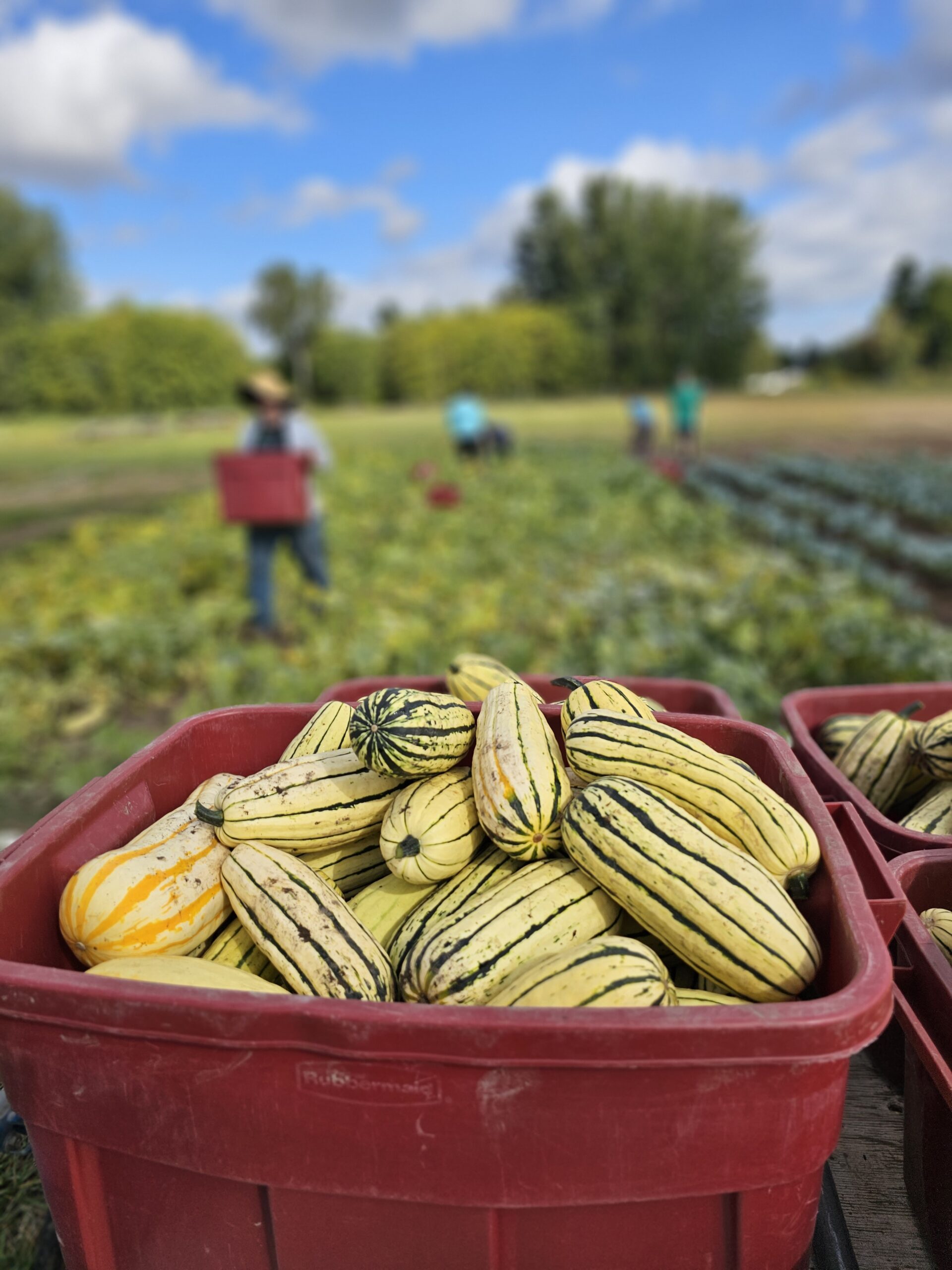
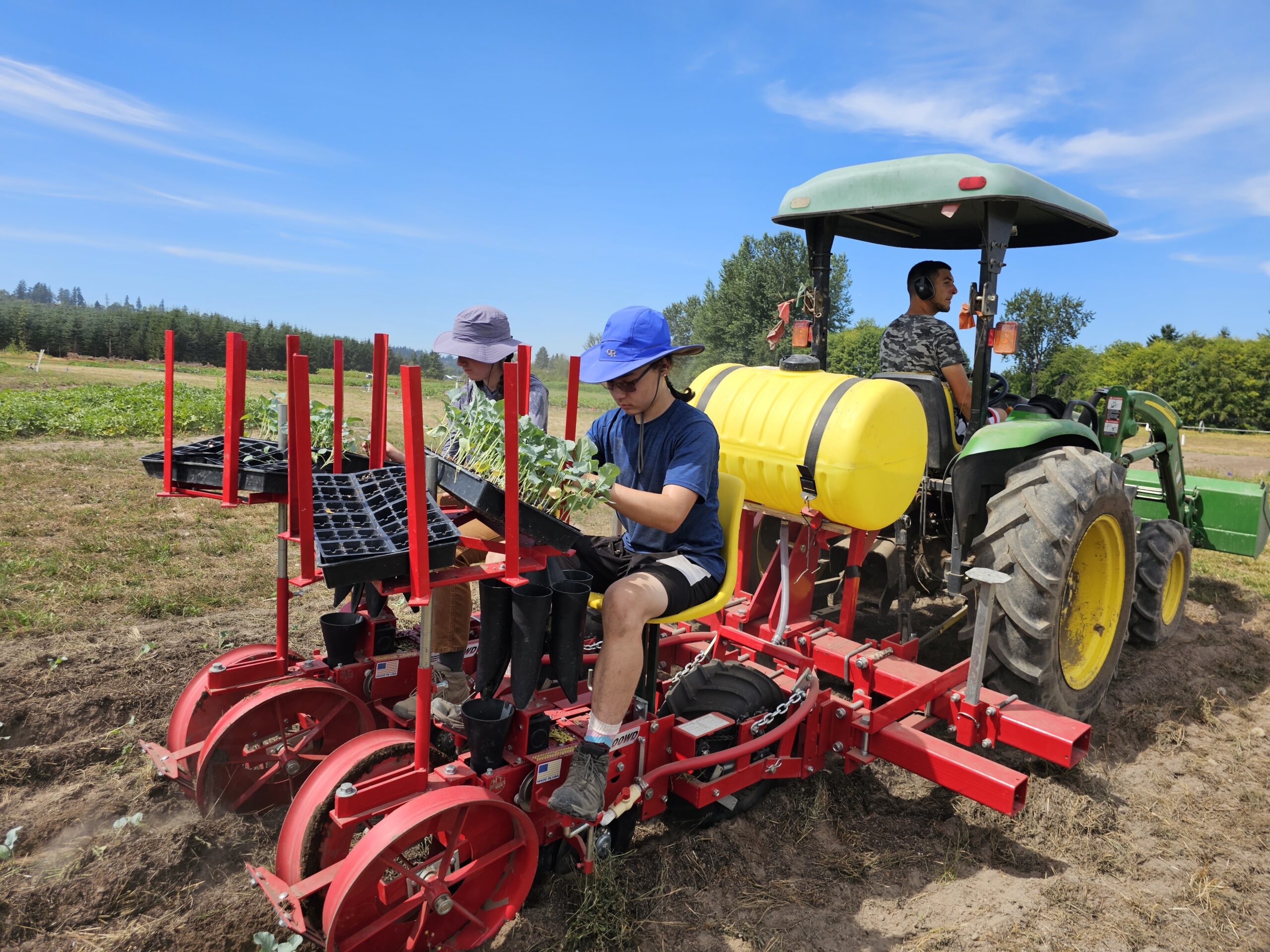
Management of the Puyallup LTARE involves numerous farming activities from late-April through mid-November. One new component of this research, compared to previous vegetable research at the Puyallup Research and Extension Center, includes production in the fall shoulder season. This is an important window for western Washington vegetable producers. Broccoli is in the field mid-July through early-November. Squash is transplanted in early June and harvested in mid-September.
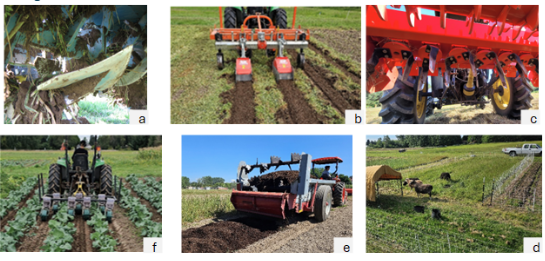
Several key management practices are shown in Figure 2 including the rotary spader used for intensive tillage and the power harrow used in the reduced-tillage treatment. The power harrow has been employed successfully to target pernicious weeds, especially perennial grasses. The tool was used at a depth of 5 cm (2 inches) approximately one time per year: 1) following squash harvest, before planting winter wheat, 2) following winter wheat, before planting fall peas or beans, 3) after compost application, before planting buckwheat cover crop.
Figure 2. Key field management operations in the Puyallup LTARE: a) rotary spader blades used in intensive tillage treatment, b) PTO-driven strip-tiller used in reduced tillage, c) power harrow used for shallow disturbance in reduced-tillage, d) sheep grazing on pasture in animal-integrated, e) applying compost, and f) interseeding winter cover crop in broccoli plots.
Management of the Puyallup LTARE involves numerous farming activities from late-April through mid-November. One new component of this research, compared to previous vegetable research at the Puyallup Research and Extension Center, includes production in the fall shoulder season. This is an important window for western Washington vegetable producers. Broccoli is in the field mid-July through early-November. Squash is transplanted in early June and harvested in mid-September.
Several key management practices are shown in Figure 2 including the rotary spader used for intensive tillage and the power harrow used in the reduced-tillage treatment. The power harrow has been employed successfully to target pernicious weeds, especially perennial grasses. The tool was used at a depth of 5 cm (2 inches) approximately one time per year: 1) following squash harvest, before planting winter wheat, 2) following winter wheat, before planting fall peas or beans, 3) after compost application, before planting buckwheat cover crop.
Links:
Cogger, C, A. Bary, A. Fortuna, L. Myhre, and D.P. Collins. 2016. Soil physical properties, nitrogen, and crop yield in organic vegetable production systems. Agronomy Journal. 108:1142-1154